
Better psychological and physical outcomes
Across 13 controlled trials, people who wrote about emotional experiences did 23% better than control groups on health and mood measures combined.
Smyth, J. Consulting & Clinical Psychology 1998 · doi
The science of journaling
Journaling is one of the most studied self-help habits there is. Below you find what the research shows for your mind, your body, your thinking and your growth, each point linked to the study behind it, and why saying it out loud works even better.
Mental health
The best-replicated effects in the whole literature are about stress, worry and mood.
Across 13 controlled trials, people who wrote about emotional experiences did 23% better than control groups on health and mood measures combined.
Smyth, J. Consulting & Clinical Psychology 1998 · doi
Putting an emotion into words reduces activity in the amygdala and engages the prefrontal regions that regulate it. So “say it and it gets smaller” describes what the brain does.
Lieberman et al., Psychological Science 2007 · doi
In a sleep lab, people who spent five minutes writing tomorrow’s to-do list before bed fell asleep roughly ten minutes sooner than those who wrote about finished tasks. Offloading works.
Scullin et al., J. Experimental Psychology: General 2018 · doi
Physical health
The original journaling studies were medical, and the body responded.
Students who wrote about their deepest thoughts for 15 to 20 minutes on four consecutive days visited the health centre less often over the next six months than students who wrote about trivial topics.
Pennebaker & Beall, J. Abnormal Psychology 1986 · doi
Participants who disclosed traumatic experiences in writing showed a better T-lymphocyte response six weeks later than controls. It was one of the first signs that expressive writing reaches the immune system.
Pennebaker, Kiecolt-Glaser & Glaser, J. Consulting & Clinical Psychology 1988 · doi
A clinical review of two decades of trials concludes that expressive writing produces measurable improvements in both physical and psychological health across many populations.
Baikie & Wilhelm, Advances in Psychiatric Treatment 2005 · doi
Thinking & memory
Unfinished thoughts occupy working memory. Writing them down gives the space back.
Students who wrote about a stressful experience gained more working-memory capacity over the following weeks than students who wrote about neutral topics. They also reported fewer intrusive thoughts.
Klein & Boals, J. Experimental Psychology: General 2001 · doi
The mechanism the research keeps pointing to: turning an experience into a story with a beginning, middle and end lets the mind file it instead of replaying it.
Pennebaker & Seagal, J. Clinical Psychology 1999 · doi
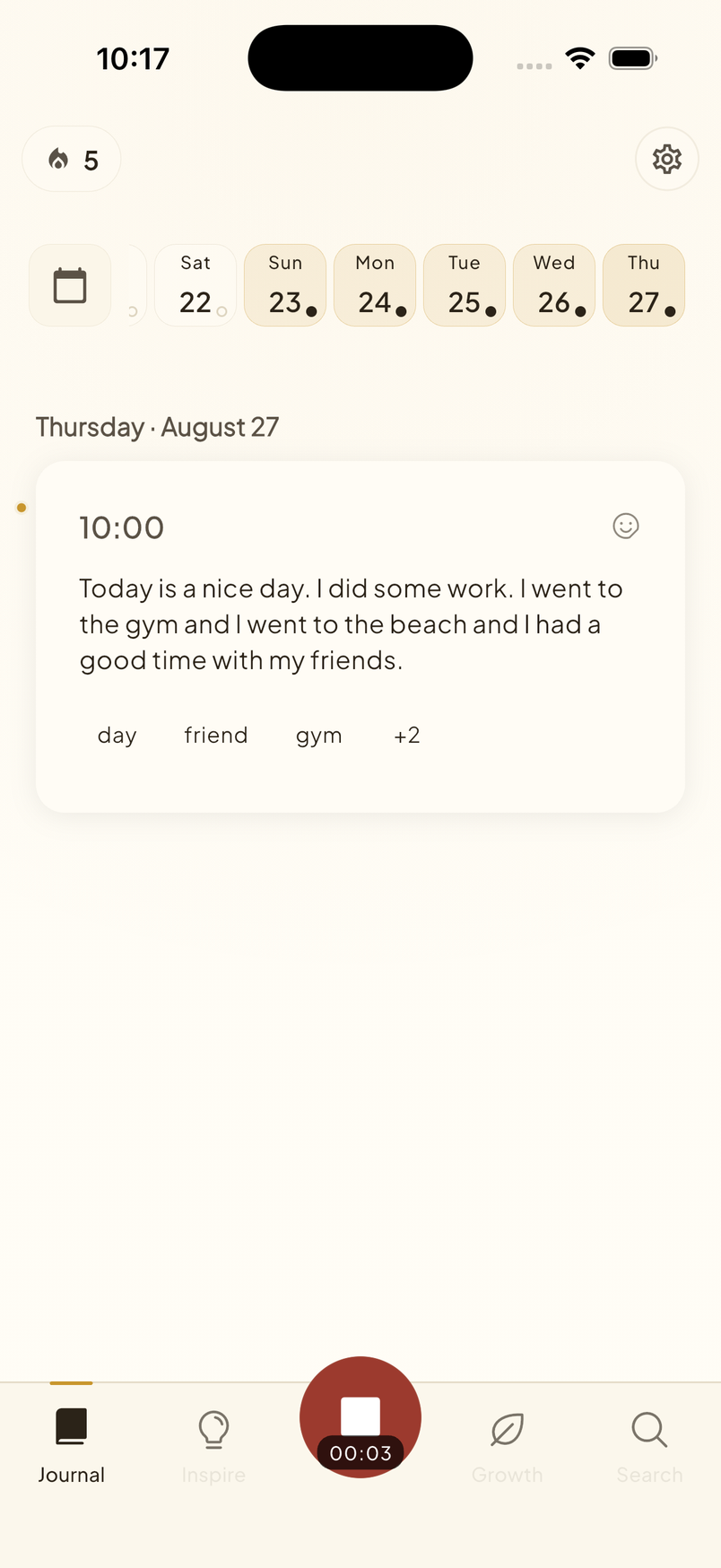
Mood, sleep, people, movement: once they are written down next to each other for a few weeks, the connections are obvious in hindsight. Maat draws that line for you.
From Maat’s own design: moods and tags are stored with every entry.
Personal growth
Compared with 43% of those who only thought about their goals. Writing the goal, naming the next action and checking in weekly were the ingredients.
Matthews, Dominican University of California 2015 · summary
People who listed things they were grateful for each week felt better about their lives, were more optimistic about the coming week and reported fewer physical complaints than those listing hassles.
Emmons & McCullough, J. Personality & Social Psychology 2003 · doi
The least scientific benefit is the one that started Maat: years from now, you will have the memories, the lessons and the proof of how far you have come.
Why voice
Every effect above comes from doing it regularly. Talking for three minutes on a walk is a habit. Sitting down to write is an appointment.
Spoken thoughts arrive before your inner editor does. The transcript keeps what you actually said, not what you would have polished.
The calming effect of labelling an emotion does not require a pen. Hearing yourself say “I’m anxious about the call” is the intervention.
A note on numbers
Every figure on this page comes from the linked study, and effects vary by person, topic and consistency. Journaling is a habit and Maat is an app. Depression and anxiety need a professional. If you are struggling, please talk to one, and keep journaling alongside.
Run the experiment on yourself
Voice first, encrypted on your phone, with a Maat Score so you can see the change as well as feel it.